

Crypto billboard advertising: formats, costs, and why it works
Crypto billboard advertising explained: Times Square boards, LED trucks, wraps, costs from $2,750/day, and why projects use it.
- crypto billboard advertising
- out-of-home advertising
- crypto marketing
- web3 marketing
- times square ads
Quick answer Crypto billboard advertising means placing physical or digital out-of-home ads for a token, exchange, or web3 project on real screens and structures: Times Square boards, LED trucks, transit sites, or one-off builds like a wrapped car. It works for crypto because it is the one ad format exchanges, wallets, and other platforms cannot easily de-platform, and it produces footage a project can use as social proof. Costs range from roughly $2,750/day for a Times Square placement to $3,500 for a Dubai Lambo wrap or an aerial banner flight, with press and KOL add-ons quoted separately.
Every crypto project that has been shadowbanned, flagged, or quietly deprioritized on a social platform eventually asks the same question: what advertising actually gets seen and can't be memory-holed. Billboards are the answer a lot of founders land on, and for good reason. A board in Times Square or a wrapped car in Dubai does not get shadowbanned. It does not depend on an algorithm's mood that week. It just runs, and it produces proof.
Why do crypto projects specifically use billboard advertising?
Three practical reasons keep coming up when founders explain why they moved budget into out-of-home.
- Platform risk. Crypto ad accounts get suspended on major ad networks with little warning and less explanation. A billboard has no ad policy to violate beyond local advertising law.
- Legitimacy signal. A token that only exists on Crypto Twitter reads as speculative. A token with a physical presence in Times Square or on a truck circling a conference reads as a project with a budget and a team behind it, which matters to exchanges, investors, and new users doing basic due diligence.
- Shareable proof. A billboard produces a photo or video the project can post, screenshot, and reuse indefinitely. That single asset often outperforms the original placement in terms of reach, because it gets re-shared across Telegram groups, Twitter, and press.
What kinds of crypto billboard placements actually exist?
"Billboard advertising" covers more formats than most founders expect going in. The main ones:
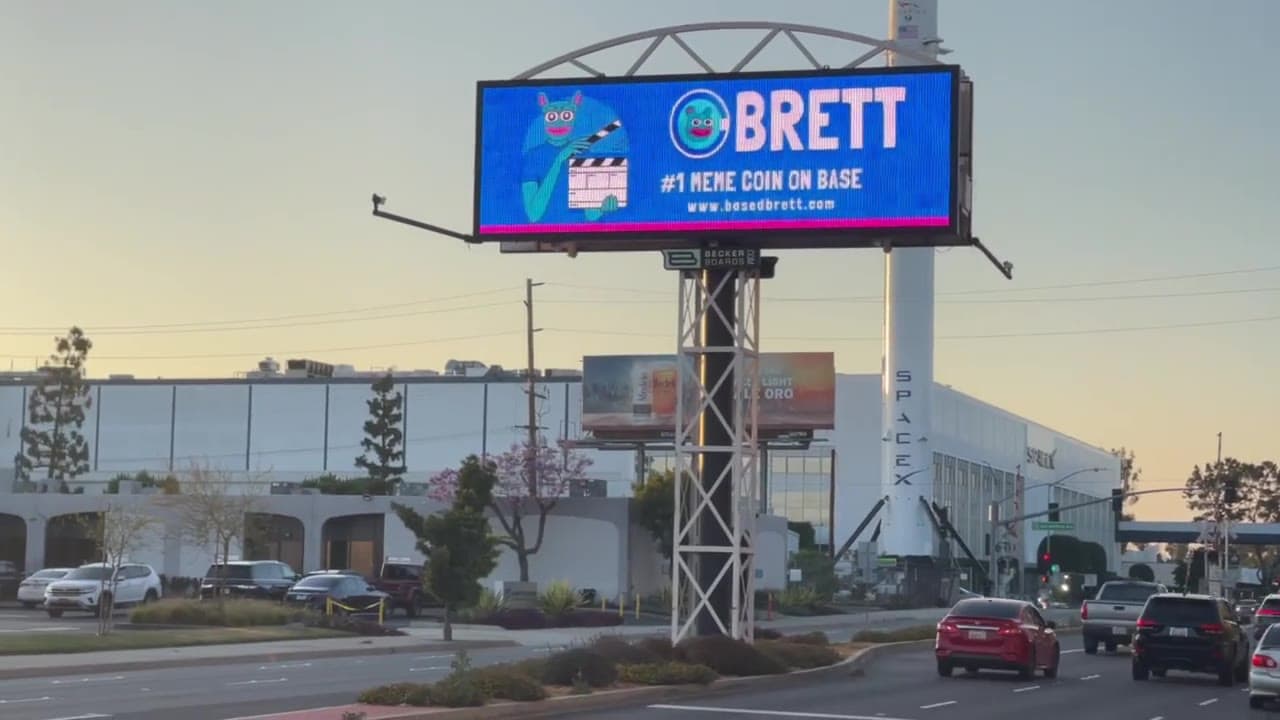
- Static and digital billboards. Times Square is the reference point everyone asks for, but city-specific and highway boards exist at every budget level.
- LED trucks. Mobile digital billboards that drive fixed routes, useful for hitting a conference district or a specific city grid over a set number of hours or days.
- Wrapped vehicles. A branded car (a Lamborghini wrap in Dubai is a common ask) works as a rolling billboard and a photo-op at the same time, particularly effective around Dubai's crypto and luxury scene.
- Aerial banners. A plane towing a banner over a beach, festival, or city skyline, commonly booked over Amsterdam and other metros for events and launches.
- Graffiti murals and QR-code OOH. Lower-cost, higher-novelty formats that work well for community-driven or meme-adjacent projects, especially when paired with a scannable QR code that routes straight into a mint or a Telegram.
Each format solves a slightly different problem. A Times Square board is a legitimacy and screenshot play. An LED truck or aerial banner is a targeted-reach play tied to a specific event or window. A wrapped car is a long-running, low-cost-per-day brand presence in a specific city. The right pick depends on what the campaign needs to prove and to whom.
Best for legitimacy and screenshot-grade proof. Roughly $2,750/day. High visibility, static location, works well alongside a press push.
Roughly $3,500. Rolling presence plus a built-in photo asset, strong fit for projects targeting Middle East or luxury-crypto audiences.
Roughly $3,500 for a 3-hour flight. Good for event windows, launches, and conference cities like Amsterdam.
How much does crypto billboard advertising cost?
Pricing varies by city, format, and duration, but the publicly quotable reference points are a Times Square billboard at around $2,750 per day, a Dubai Lambo wrap at around $3,500, and an aerial banner flight at around $3,500 for a three-hour flight. LED trucks, graffiti murals, QR-code OOH, and multi-city or multi-week bookings are quote-based since they scale with route length, market, and duration. Anyone quoting a flat national number for "crypto billboard advertising" without asking about market and format is guessing.
How does a crypto billboard campaign actually get shipped?
The mechanics matter more than the pitch. A placement needs: a confirmed site or route, creative sized correctly for that specific board or vehicle, a booked flight window if it is a digital board, and someone on the ground to capture time-stamped footage once it runs. Projects that go through a broker often lose visibility on exactly which of those steps happened and when. EAC operates its placements directly rather than reselling a vendor list, books through Telegram straight to the person running the campaign, and hands back footage and links as proof once it airs.
The Times Square placements, the Dubai wrap, and the aerial banner flights are not just services on a list, they are placements EAC has actually run and can show. That is the standard worth holding any billboard vendor to before paying a deposit: can they show you footage of something they shipped, not just a rate card. See real examples on the billboards page, and the full list of surfaces EAC operates, from OOH to press to KOL to Asia-market reach, is on the services page.
Does a billboard alone move the needle, or does it need to be paired with something?
A billboard on its own is a photo. Paired with press coverage, it becomes a story with a live link a journalist or aggregator can cite. Paired with KOL amplification, the photo gets pushed into timelines that already have crypto-native attention. Paired with Chinese-market channels (CnToken, HKDefi banners, WeChat, Xiaohongshu KOLs), the same placement reaches an audience that most Western-focused campaigns never touch. The billboard is the anchor asset. What surrounds it determines whether it is seen by a few thousand people walking past, or by everyone who follows the accounts that reshare it afterward.
A billboard that nobody photographs is just a rented sign. The point is the proof it produces, not the sign itself.
What should a founder check before booking a crypto billboard?
- Real inventory vs. resold inventory. Ask directly whether the vendor owns or operates the placement or is subcontracting it. Resold bookings add a markup and a point of failure.
- Proof format. Confirm upfront that you will get time-stamped video or photo of the actual placement, not a stock render of "what the board could look like."
- Local ad rules. Some cities and countries restrict crypto-specific advertising language. A vendor who has actually run crypto boards before will know which cities are fine and which need copy adjustments.
- Timing around other activity. A billboard that runs the same week as a press release or listing announcement gets far more mileage than one that runs in isolation.
Frequently asked questions
Is crypto billboard advertising legal?
Yes, in most jurisdictions, though a handful of cities and countries have restrictions on crypto-specific claims or require disclaimers. A vendor with actual crypto placement experience will know which markets need adjusted copy and which are open.
How much does a Times Square crypto billboard cost?
Around $2,750 per day for a standard placement. Cost scales with duration, screen size, and rotation frequency, so multi-day bookings should be quoted directly rather than estimated from a single day's rate.
Do crypto billboards actually drive users or just awareness?
Billboards are primarily an awareness and legitimacy tool, not a direct-response channel, though QR-code formats can drive immediate traffic to a mint, app, or Telegram. Their bigger value is usually the reusable photo or video asset, which gets reshared far beyond the people who saw the physical board.
What's cheaper: a billboard or an LED truck?
It depends on market and duration, but LED trucks are often more cost-efficient for hitting a specific area over a short window, like a conference district for a few days, while a fixed billboard makes more sense for sustained presence in one high-traffic spot. Both are quote-based once you specify city, route, and length.
Ready to put this into a campaign?
Explore the services, the billboards showcase, and the surfaces we operate across — then book on Telegram. Confidential. NDA available on request.