

Crypto billboard advertising agency: who owns the screen?
A crypto billboard advertising agency should book the placement directly and send timestamped proof before you pay the second invoice.
- crypto billboards
- ooh advertising
- crypto marketing agency
- web3 marketing
- token launch promotion
Quick answer A crypto billboard advertising agency books and operates physical out-of-home placements (Times Square, LED trucks, vehicle wraps, aerial banners) for crypto and web3 projects, and returns proof of the run instead of a media plan. EAC runs these placements directly, not through a vendor list, and hands back time-stamped footage of every campaign.
Anyone can email you a rate card for a digital billboard network. The question that matters is who actually controls the screen, the truck, or the wall, and who will send you footage of your ad running before you pay the second invoice.
What does a crypto billboard advertising agency actually do?
A crypto-focused OOH agency does two things a generic ad agency and a generic billboard broker both struggle to do at once: it understands the crypto audience (CT, conference crowds, exchange launches, token unlocks) and it operates real physical inventory instead of reselling programmatic slots. That means booking a Times Square spot for a launch week, wrapping a vehicle in Dubai for a conference, or flying a banner over a beach during a major event, then handing the client proof: a photo, a video, a timestamp.
Most agencies that show up in a search for this term are broad crypto marketing shops that list billboards as one line item among paid media, influencer campaigns, and community management. That is fine if you want a bundled retainer. It is not the same as working with an operator who owns the relationship with the screen or the truck.
Why do crypto projects specifically use billboards?
Token projects have a trust problem that most consumer brands don't. A logo on a Times Square screen or a wrapped car in Dubai is a physical, verifiable object. It can't be faked with a screenshot the way a fabricated Twitter engagement number can. For a project trying to prove it's real, funded, and moving, physical placement does something a paid social impression never will: it exists in the world, and anyone can go check.
- Legitimacy signal: a billboard says the project has budget and intent, which matters during a listing push or token generation event.
- Screenshot-ready proof: founders need assets for their own Twitter and Telegram, and OOH generates them without staging anything.
- Conference and event timing: placements timed to a major crypto event (Consensus, Token2049, Dubai's various summits) put the brand in front of the exact audience that's already paying attention.
- Cut-through: most crypto marketing is banner ads and KOL threads. A billboard or an LED truck is a different medium entirely, and it stands out because almost nobody else in the space is doing it well.
What kinds of billboard and OOH placements exist for crypto projects?
"Billboard" undersells the category. The actual toolkit looks like this:
- Times Square and global billboard screens: the classic legitimacy play, bookable by the day.
- Mobile LED trucks: drivable billboards that can circle a conference venue, a city block, or an exchange's HQ.
- Vehicle wraps: a wrapped Lamborghini in Dubai gets photographed by people who don't even know what the project is, which is its own kind of reach.
- Aerial banner flights: a banner towed behind a plane over a beach or event, effective for high-attendance outdoor moments like festivals or waterfront conferences.
- Graffiti murals and guerrilla placements: for projects that want street credibility rather than a corporate billboard look.
- QR-code OOH: billboards and posters built around a scannable code, turning a passive ad into a direct funnel to a mint page or app download.
Full detail on each format, plus current day-rate pricing where it's public, is on the billboards page.
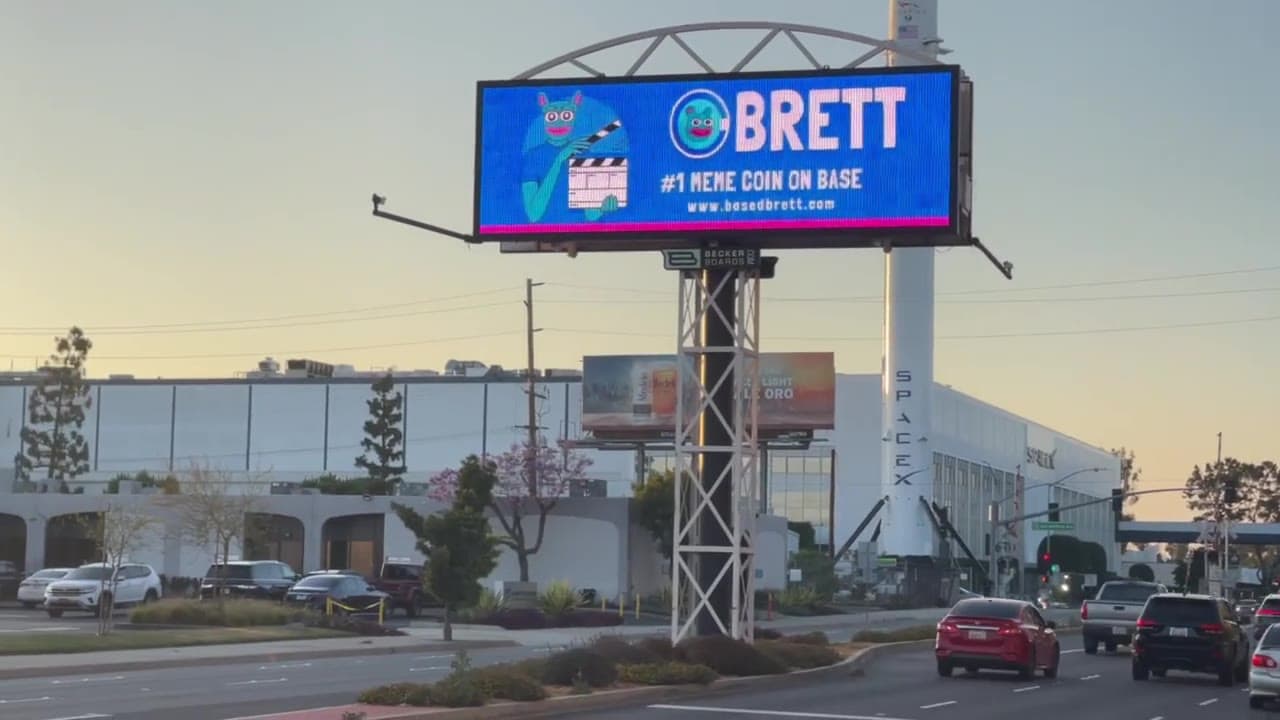
EAC has run Times Square placements, the Dubai Lambo wrap, and aerial banner flights over Amsterdam and other metros, and every one of them comes back as footage the client can screenshot and verify, not a promise on a call. That's the standard to hold any agency to before paying a deposit: ask for proof of a placement they've actually run, not a rate card. See the full run-down on the billboards showcase or the wider services overview for how OOH fits alongside press and KOL work.
How much does crypto billboard advertising cost?
Pricing varies by format and market, but publicly quoted rates give a sense of scale:
| Placement | Typical rate |
|---|---|
| NYC Times Square billboard | ~$2,750/day |
| Dubai Lambo wrap | ~$3,500 |
| Aerial banner flight (3-hour) | ~$3,500 |
LED trucks, murals, and QR-code OOH are quoted based on city, duration, and route, so those run on a request basis. There's no reason to accept a vague "contact us for enterprise pricing" answer for the standard formats above. If an agency won't give you a ballpark, that's worth noticing.
How do you pick between a crypto billboard agency and a generalist OOH broker?
The generalist OOH brokers (the ones selling "thousands of options for traditional and digital billboards") are built for consumer brands buying national ad inventory at scale. They can get you a screen. What they usually can't do is think like a crypto marketer: timing a placement to a token unlock, pairing it with a KOL push so the billboard photo circulates on CT the same week, or coordinating it with a press release so the launch has a coherent story across formats.
Understands token launch timing, conference calendars, and how to package a billboard run with PR and KOL activity. Returns footage as proof. Books direct via Telegram, no agency layers.
Deep inventory across traditional ad categories, but no context on crypto audiences, no bundling with press or influencer work, and often a reseller markup on top of the media cost.
Should billboards be paired with PR and KOL activity?
A billboard by itself is a photo op. A billboard timed to a press release hitting tier-one outlets and a wave of CT KOL posts is a coordinated launch moment, and it reads very differently to anyone doing due diligence on the project. This is the actual gap between an OOH-only vendor and a shop that runs press, KOL, and Asia-market channels alongside the physical placements. If the plan is a Times Square screen the same week as a listing announcement, the press and KOL side needs to be lined up in parallel, not bolted on after the fact. That's the full scope covered on the services page.
A billboard proves you exist in the physical world. Pairing it with a live press link and a KOL thread proves you exist everywhere your audience is looking that week.
How does booking actually work?
No decks, no multi-week onboarding calls. EAC books through Telegram, direct to the operator running the placement. You describe the launch, the timing, and the market, and get a straight quote back for the format that fits, whether that's a single Times Square day, an LED truck route, or an aerial banner flight timed to a conference. Placements are handed back as time-stamped footage or live links, not a recap deck three weeks later.
What should you check before hiring any crypto OOH agency?
- Ask for footage or photos of a placement they've actually run, not stock imagery from the billboard vendor's own marketing.
- Confirm whether they operate the placement directly or resell it through another vendor (resale usually means slower turnaround and a markup).
- Get a specific rate for the specific format, not a "packages start at" number designed to get you on a call.
- Check whether they can bundle the OOH run with press or KOL timing, since a standalone billboard has less impact than one wired into a launch narrative.
How much does a crypto billboard cost?
Publicly quoted rates run around $2,750/day for a Times Square billboard, $3,500 for a Dubai vehicle wrap, and $3,500 for a 3-hour aerial banner flight. LED trucks, murals, and QR-code OOH are quoted by city and duration, so those need a direct request.
Do crypto billboards actually work for token launches?
They work best as a trust and visibility signal rather than a direct-response channel. A billboard proves budget and intent, gives the team screenshot-ready proof for social, and cuts through a feed full of paid ads and KOL threads. Pairing it with a press release or KOL push timed to the same week gets more out of the placement than running it alone.
What's the difference between a crypto billboard agency and a regular OOH broker?
A regular broker has deep inventory across all ad categories but no context on token launch timing, conference calendars, or how to coordinate a billboard with press and KOL activity. A crypto-native operator books the same physical formats but times them to the project's actual launch moments and can bundle them with the rest of a campaign.
Can I get proof that my billboard actually ran?
Yes, and you should insist on it before paying full price. EAC hands back time-stamped footage or photos of every placement, whether it's a Times Square screen, an LED truck route, or an aerial banner flight, so the client can verify and reuse the footage rather than take a vendor's word for it.
Ready to put this into a campaign?
Explore the services, the billboards showcase, and the surfaces we operate across — then book on Telegram. Confidential. NDA available on request.