

Crypto Billboard Advertising: A Practical Guide to Out-of-Home
How crypto billboard and out-of-home advertising works: Times Square, LA freeway boards, a Dubai Lambo wrap, aerial banners, and how to turn it into proof.
- billboards
- out-of-home
- crypto advertising
- Times Square
Quick answer Crypto billboard advertising places a project on physical out-of-home (OOH) surfaces: Times Square and a Hong Kong board, Los Angeles freeway billboards, a wrapped Lamborghini in Dubai, aerial banner flights over Amsterdam, and hand-painted murals. The point is credible, photographable reach a project can document and reshare. EAC operates these placements directly and hands every one back as time-stamped footage you can screenshot and verify.
Out-of-home is the oldest form of advertising and one of the few a crypto audience still screenshots. A board in the right place, filmed well, becomes a social asset that outlives the day it ran. The mistake is treating it as a vanity spend instead of a documented one. This guide covers the formats that work for crypto, the real placements EAC runs, what they cost, and how a billboard becomes proof rather than a photo nobody sees.
What counts as crypto billboard advertising?
Out-of-home is any advertising that reaches people in physical space rather than in a feed. For crypto projects, the formats that consistently earn attention fall into a few groups, and most campaigns mix them.
- Fixed billboards: static and digital boards in high-traffic locations, from Times Square to Los Angeles freeway sites to a board in central Hong Kong.
- Mobile placements: a wrapped vehicle that brings the ad to the audience, like a Lamborghini working Dubai's busiest streets and landmarks.
- Aerial banners: a banner flown over a city or an event, timed to the moment the crowd is largest.
- Guerrilla and street: commissioned murals and hand-painted placements that read as part of the city rather than an ad slot.
EAC runs all of these as part of the out-of-home service lane, and the surfaces are real bookings rather than a catalog of what is theoretically possible.
Which billboard placements does EAC actually run?
The out-of-home lane is built from placements EAC has booked and filmed, not a stock media list. A few of them:
- NYC Times Square: a board in the most recognized advertising location in the world, around $2,750 for a one-day run.
- Hong Kong: a premium board in one of Asia's busiest business and retail districts, also around $2,750 a day, useful for projects aimed at Asian markets.
- Los Angeles freeway boards: Lynwood, Hawthorne, Compton, and Norwalk sites, roughly $1,100 to $1,150 for a full week, strong commuter reach at a fraction of a marquee board.
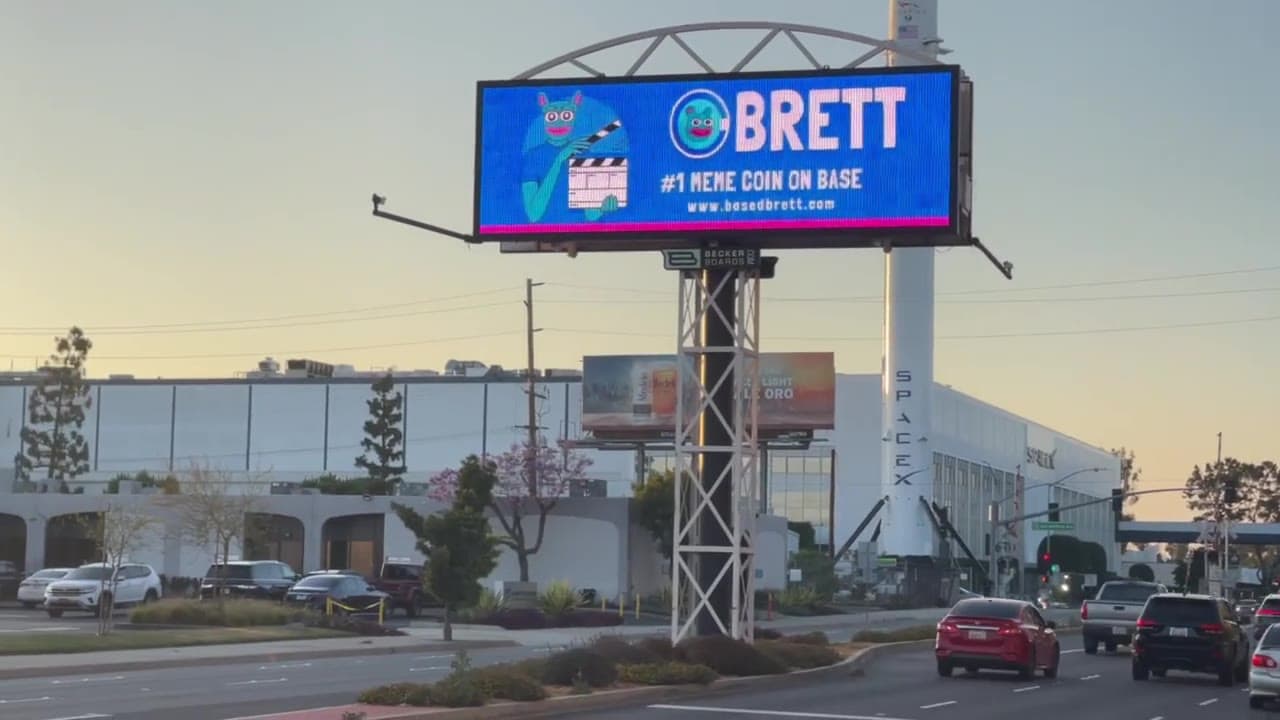
- SpaceX factory board (Los Angeles): a digital billboard beside the SpaceX factory in a heavy tech corridor. It is the board clients book most, and it is quoted on request.
- Dubai Lambo wrap: a fully wrapped Lamborghini past the Burj Khalifa and Burj Al Arab, around $3,500.
- Amsterdam aerial banner: a banner flight over the city, around $3,500 for a three-hour flight.
- London mural: a hand-painted street placement in one of Europe's most-watched markets, around $2,000.
The full lineup, with footage of each, is on the billboards showcase.
How much does crypto billboard advertising cost?
Out-of-home has one advantage over most crypto marketing: the prices are physical and public, so you can compare them before you book. A Times Square or Hong Kong board runs about $2,750 a day. Los Angeles freeway boards are roughly $1,100 to $1,150 for a full week. A Dubai Lambo wrap and an Amsterdam banner flight are each around $3,500, and a London mural is about $2,000. A couple of placements, like the SpaceX factory board, are quoted on request because the rate moves with timing and availability.
What you will not get is an invented view count. Impression figures for OOH are estimates at best, and the honest deliverable is the footage plus a record of where and when the placement ran, not a number nobody can check.
How do you choose a format?
There is no single best format. It depends on whether you want density, motion, or novelty, and on where the audience actually is.
| Format | Reach style | Best for |
|---|---|---|
| Times Square / Hong Kong boards | Fixed, high-density | Launches and prestige signal |
| LA freeway boards | Fixed, commuter | Sustained local reach on a budget |
| Dubai Lambo wrap | Mobile, novelty | Social-first footage |
| Amsterdam aerial banner | Aerial, event-timed | Conferences and crowds |
| London mural | Fixed, guerrilla | A permanent-feeling local presence |
A launch moment usually wants a marquee board for the prestige signal. A project trying to travel on social often gets more from the wrap or the mural, because novelty formats are built to be filmed.
EAC's out-of-home runs are the clearest evidence of the "operate it directly" claim: a board in Times Square, a wrapped Lamborghini circulating Dubai, and an aerial banner over Amsterdam, each handed back as footage the client could verify on the spot rather than a mockup sent after the fact. That same standard applies to the press and KOL lanes. See the runs on the billboards showcase, and how the lanes combine on services.
How do you turn a placement into proof?
A billboard nobody photographs is a billboard nobody remembers. Every booking should come back with time-stamped footage and a record of the location and run dates, so the placement becomes two things at once: a reusable social asset, and a receipt you can show investors or partners.
The other half is stacking. A single out-of-home moment goes further when it runs alongside press that gives the story a citable source, and social creative built to carry the footage. One booking, filmed once, can feed a press hit, a Twitter clip, and a community post in the same window.
The placement is half the work. The footage is the other half.
How much does crypto billboard advertising cost?
It depends on the format and city. A Times Square or Hong Kong board is around $2,750 a day, Los Angeles freeway boards run about $1,100 to $1,150 for a week, and a Dubai Lambo wrap or an Amsterdam banner flight is around $3,500. A few placements, like the SpaceX factory board, are quoted on request. Contact an operator for a quote against your dates.
Which cities can EAC place in?
Times Square and Hong Kong for marquee boards, Los Angeles for freeway billboards and the SpaceX factory board, Dubai for the wrapped Lamborghini, Amsterdam for aerial banner flights, and London for a hand-painted mural. The current lineup with footage is on the billboards showcase.
Do I get proof the placement ran?
Yes. Every out-of-home booking comes back with time-stamped footage and a record of where and when it ran. EAC does not report estimated impression numbers, because those cannot be independently verified. The footage can.
Does out-of-home work on its own?
Rarely. A board earns its cost when it is documented and stacked with other surfaces: press for a citable source, and social creative to carry the footage. Run in isolation and undocumented, it is a vanity spend. Run as a filmed moment inside a wider campaign, it is proof the project is real.
Ready to put this into a campaign?
Explore the services, the billboards showcase, and the surfaces we operate across — then book on Telegram. Confidential. NDA available on request.