

How to advertise crypto on billboards: a founder's guide
How to advertise crypto on billboards, pick the right placement, book it, and get proof footage that turns into content.
- billboard advertising
- crypto marketing
- token launch
- led trucks
- out of home advertising
Quick answer To advertise crypto on billboards, pick a placement that fits your announcement (Times Square for a token launch, LED trucks for a targeted city push, a wrapped vehicle for sustained street presence), book directly with an operator who runs the physical placement, and get time-stamped footage back as proof. Budget from roughly $2,750/day for a Times Square spot to $3,500 for an aerial banner flight or a Dubai Lambo wrap. Timing it around a real catalyst (mainnet launch, exchange listing, TGE) matters more than the size of the screen.
Billboard advertising works for crypto projects because it is the one channel that is impossible to fake. A tweet thread can be bought in bulk. A billboard in Times Square cannot, everyone walking past it saw the same thing at the same time. That is the entire appeal, and it is also why founders get it wrong: they treat it like a banner ad instead of a proof event.
Why do crypto projects use billboards at all?
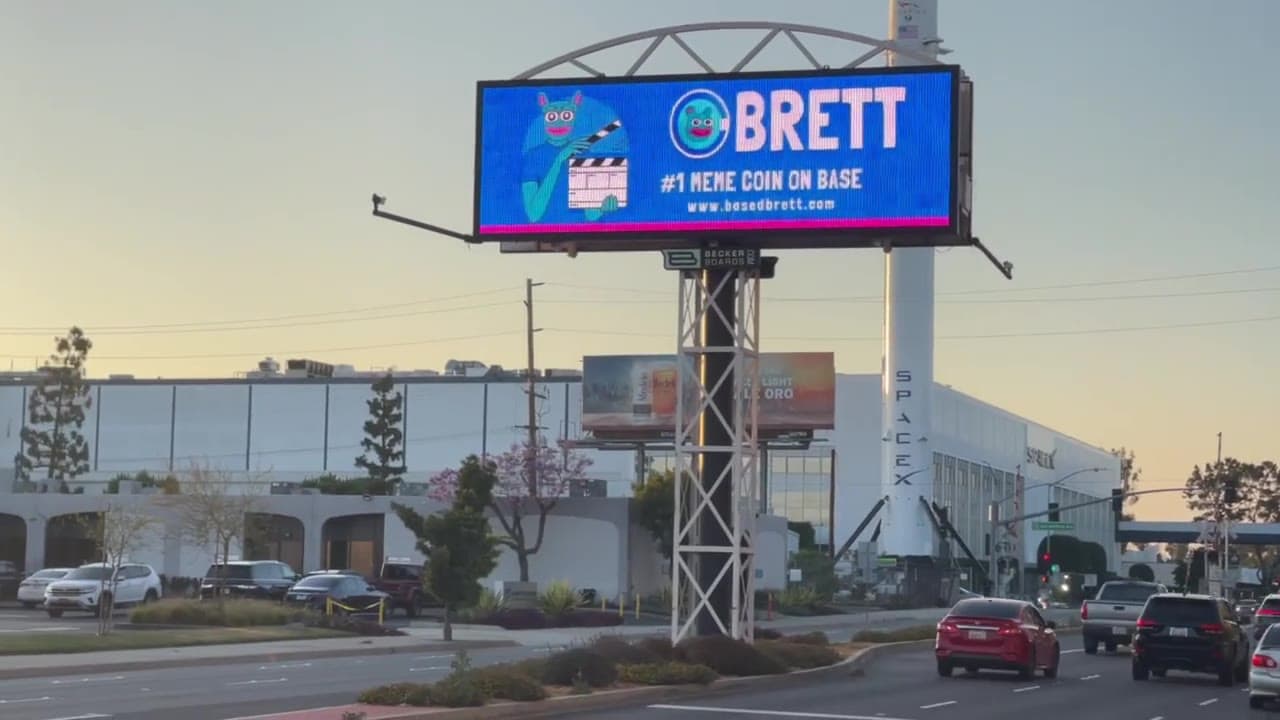
Because it signals something a tweet cannot: real money spent on a real, physical, unfakeable placement. A Times Square billboard or a wrapped Lambo in Dubai tells a community "this project has budget and is willing to put it on the street," which reads differently than a paid Twitter thread. It also gives you something to screenshot, film, and repost, which turns one placement into weeks of secondary content.
The mistake most projects make is running a billboard with no other campaign around it. A billboard is a proof point, not a full strategy. It works best stacked with press coverage and KOL amplification so the physical placement gets a second life online.
Which type of billboard fits a crypto launch?
There is no single "best" format. The right one depends on what you are announcing and who needs to see it.
- Times Square / major-metro billboards: best for token launches, listing announcements, or anything you want the whole crypto Twitter timeline to screenshot. High visibility, high credibility signal.
- LED trucks: mobile billboards that can park outside a conference, exchange HQ, or specific neighborhood. Good for targeted moments like a conference activation rather than broad brand awareness.
- Wrapped vehicles (like a Lamborghini in Dubai): sustained visibility over days or weeks, plus strong photo and video content for social. Works well for projects with a lifestyle or luxury angle.
- Aerial banner flights: a plane towing a banner over a beach, city, or event. Novel enough to get filmed by bystanders, which extends reach past the people who physically saw it.
- Graffiti murals / QR-code OOH: lower cost, longer dwell time, good for community-driven projects that want a piece of city rather than a flash moment.
How much does crypto billboard advertising cost?
Pricing is placement-specific and public where it can be. A Times Square billboard runs around $2,750 per day. A Dubai Lambo wrap is around $3,500. An aerial banner flight (a 3-hour flight) is roughly $3,500. LED trucks, murals, and multi-day packages are quoted based on city, duration, and route, so those go through a direct quote rather than a flat number.
The bigger cost mistake isn't the placement, it's running one day of billboard with nothing to point people toward. Budget for the footage capture and the follow-up content push, not just the screen time.
How do you actually book a billboard for a crypto campaign?
- Pick the moment. Tie the placement to something real: mainnet launch, listing, TGE, major partnership. A billboard with no news attached just burns budget.
- Pick the city and format. Times Square for maximum screenshot value, a wrapped vehicle or LED truck if you need sustained or mobile presence, an aerial banner for something unusual enough to get filmed.
- Confirm the creative fits outdoor. Billboard creative needs to work in three seconds from a moving car or a crowded sidewalk: big logo, short line, no fine print.
- Book directly with the operator. Going through a reseller adds a markup and a layer of guesswork about what actually gets delivered. Book with whoever runs the physical placement.
- Get the placement back as proof. Time-stamped footage or photos, not a promise that it ran. This is what you post, and what press or KOLs will reference if you brief them afterward.
EAC runs these placements directly rather than reselling a vendor list, Times Square billboards, LED trucks, the Dubai Lambo wrap, aerial banner flights, and hands back verifiable footage of everything that ships. If you want to see what the actual placements look like before booking, the billboards showcase has the real formats and proof shots, and the full lane of what EAC operates, press, KOL, Asia market, creative, is on the services page.
Should a billboard stand alone or run with other channels?
Stand alone, and a billboard is a nice photo. Stack it with press and KOL amplification, and it becomes a campaign. A common sequence: line up tier-one or tiered press coverage to run the same week, brief a handful of CT KOLs to post the billboard footage as it happens, then let the community reshare it. The billboard gives everyone downstream something concrete to point at instead of a generic announcement graphic.
For projects targeting Asia specifically, pairing an OOH placement with Chinese CT KOLs, WeChat pushes, or Little Red Book coverage extends the same physical proof into a market that billboards alone won't reach. The placement is the anchor, the distribution around it is what turns a few hours of screen time into a week of content.
What actually makes billboard creative work for crypto?
Outdoor advertising has none of the context a landing page gives you. People see it for a few seconds, often from a distance or in motion. That means:
- Logo and project name need to be legible instantly, not stylized into unreadability.
- One line of copy, not a pitch. "Mainnet live" beats a tagline about disrupting finance.
- A QR code only works if there's a reason to scan it on the spot (a live mint, a claim window), not a generic link to a homepage.
- Design for the photo. Most of the value of a billboard comes from people photographing it and reposting, so the composition should look good in a phone screenshot, not just from the street.
What's the actual timeline for a billboard placement?
Physical OOH generally needs more lead time than digital ads: booking slots, confirming creative specs, and printing or installing wraps all take days, not minutes. Times Square and major-metro billboard slots can sometimes be booked with a short lead time if inventory is open, but wraps and murals need longer for production. Aerial banner flights depend on weather windows and airspace clearance, so build in a buffer rather than scheduling a flight for the exact hour of a launch.
The practical move is to lock the placement and creative early, then hold the exact air date loose until the announcement date is confirmed. Booking through a direct operator on Telegram rather than a multi-step agency process cuts a lot of the back-and-forth out of that timeline.
How much does it cost to put crypto ads on a billboard?
It depends on format and city. A Times Square billboard is around $2,750 per day, a Dubai Lambo wrap runs about $3,500, and an aerial banner flight is roughly $3,500 for a 3-hour flight. LED trucks, murals, and multi-day runs are quote-based depending on route and duration.
Is a Times Square billboard worth it for a small crypto project?
It's worth it if you have a real moment to attach it to, a token launch, a listing, a major partnership, and a plan to capture and repost the footage. Without a news hook or a distribution plan around it, you're paying for screen time with no lasting content out the other end.
Do crypto billboard companies handle the design too?
Creative and design is usually a separate service from the physical placement, though some operators handle both. Either way, the creative needs to be built for outdoor from the start: legible fast, minimal text, designed to photograph well, not a resized version of your website banner.
Can you actually prove a crypto billboard ran?
Yes, and you should insist on it. A legitimate placement comes back with time-stamped footage or photos of the actual billboard in place, not a mockup. That proof is also what makes the placement usable afterward, for press pitches, KOL briefs, and community posts.
Ready to put this into a campaign?
Explore the services, the billboards showcase, and the surfaces we operate across — then book on Telegram. Confidential. NDA available on request.