

Outdoor crypto advertising: formats, costs, and why it works
Outdoor crypto advertising explained: billboards, LED trucks, and wraps that skip ad bans and give founders proof to share.
- outdoor advertising
- crypto marketing
- ooh advertising
- billboard advertising
- crypto ads
Quick answer Outdoor crypto advertising means putting a project in front of people through physical placements: Times Square billboards, LED trucks, wrapped vehicles, aerial banners, and guerrilla installs, instead of relying only on banner ads and Twitter threads. It works for crypto projects because most digital ad networks (Google, Meta) restrict or ban crypto ads outright, and OOH gives founders a channel with no platform account to get banned, plus footage they can use as proof across every other channel.
Crypto marketing has a platform problem. Google Ads gates most token and exchange campaigns behind an approval process that can take weeks or reject you outright. Meta has run hot and cold on crypto for years. That has pushed a real share of project budgets outdoor, into billboards, trucks, wraps, and aerial banners that nobody can shadowban.
This isn't a new trick. Exchanges have run Times Square and Vegas Sphere buys for years, and smaller projects have followed with LED trucks and local billboards because the physical placement does something digital ads can't: it exists whether or not an algorithm approves of the word "crypto." Below is what actually works, what it costs, and how to think about picking placements instead of just buying whatever a vendor pitches you.
Why do crypto projects use outdoor advertising instead of digital ads?
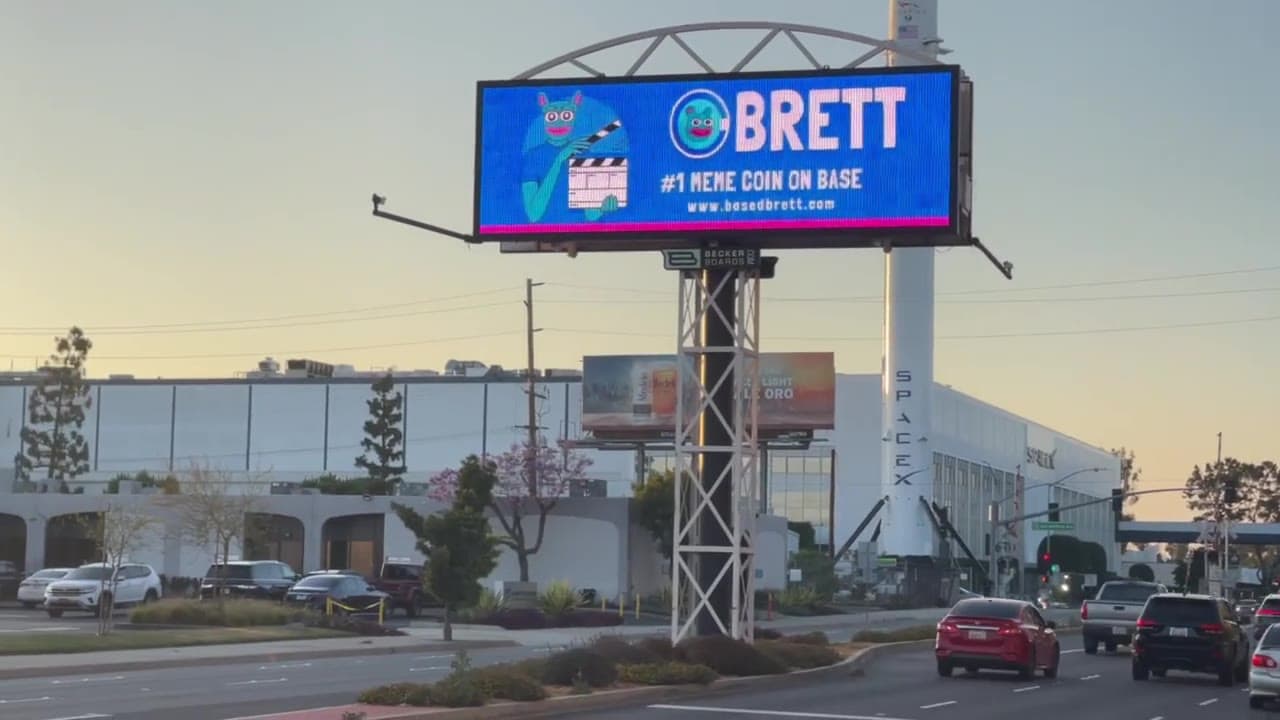
Three practical reasons. First, platform risk: crypto ad accounts get flagged, paused, or banned with little warning, and rebuilding an ad account mid-campaign kills momentum. Second, credibility: a billboard in Times Square or a wrapped Lamborghini in Dubai signals a level of budget and seriousness that a Twitter ad doesn't, especially to an audience that has seen a thousand rug pulls promoted through paid social. Third, proof: outdoor placements produce footage. A screenshot of a paused ad account proves nothing. A video of your logo on a billboard, timestamped and geolocated, is something a founder can post, and something a skeptical community member can go verify in person.
What outdoor formats actually work for crypto projects?
- Times Square and metro billboards, the highest-recognition placement in crypto marketing, largely because it's been used by enough major exchanges that the format itself now reads as "this project has real backing."
- LED trucks, mobile billboards that can circle a conference venue, a city's financial district, or a specific event, giving you control over exactly where and when the impressions happen.
- Wrapped vehicles, a wrapped Lamborghini running through Dubai works less as mass reach and more as a shareable asset: the kind of clip that gets reposted because it looks like something, not just an ad slot.
- Aerial banner flights, a banner towed over a beach, festival, or metro skyline, effective for hitting a dense crowd at a specific event window rather than general traffic.
- Graffiti murals and guerrilla installs, lower cost, higher local texture, useful for projects that want a grassroots look rather than a corporate one.
- QR-code OOH, billboards or wraps built around a scannable code, turning a passive impression into a direct funnel to a mint page, app download, or Telegram group.
For a full breakdown of formats, markets, and how placements get delivered as verifiable footage, see EAC's billboards page.
How much does outdoor crypto advertising cost?
Pricing varies a lot by format and market, but rough public benchmarks: a Times Square billboard runs around $2,750/day, a Dubai Lambo wrap runs around $3,500, and a 3-hour aerial banner flight runs around $3,500. Local billboards in smaller metros cost less; longer bookings usually bring the day rate down. LED truck routes and graffiti murals are typically quoted per project since the scope (route length, wall size, number of days) changes the price directly, so those get quoted on request rather than listed as a flat rate.
How do you pick the right outdoor format for your budget?
Match the format to what you're actually trying to prove. A token launch trying to signal legitimacy to a skeptical audience benefits from a recognizable market like Times Square, because the audience already associates that placement with scale. A project targeting a specific conference or city benefits more from an LED truck or aerial banner timed to the event, since it puts the message in front of the exact crowd rather than general foot traffic. A project trying to build a cult following benefits from a mural or a wrapped car, something with personality that gets reposted organically instead of just being seen and forgotten.
The mistake most projects make is buying the format that looks best in a deck instead of the one that fits the audience they're actually trying to move. A billboard nobody in your target community drives past is expensive scenery.
Best for: legitimacy signal, screenshot-and-share proof, broad brand awareness. ~$2,750/day.
Best for: hitting a specific venue, city district, or conference crowd on a controlled route. Quote on request.
Best for: shareable, personality-driven content over raw impression count. ~$3,500.
Best for: dense event or beach crowds in a fixed time window. ~$3,500 (3-hour flight).
Does outdoor advertising actually reach crypto-native audiences?
Outdoor alone doesn't reach a crypto-native audience the way a CT KOL thread does. It reaches everyone else, and it reaches the crypto-native audience secondhand, through the clips and screenshots that circulate after the placement goes live. That's why outdoor tends to work best paired with something that carries the footage further: a press hit that embeds the billboard photo, a KOL who posts the truck driving past a conference, a Chinese-market push that picks up the same asset for a different audience. Outdoor gives you the raw material; distribution decides how far it travels.
EAC runs both sides directly rather than handing off between vendors. Press placements come back as live URLs, not screenshots you have to take on faith. Billboards, trucks, and aerial flights come back as timestamped footage. That combination, physical placement plus proof plus distribution, is what turns an outdoor buy into something a project can actually use, not just something it paid for.
EAC has run Times Square billboard placements, a wrapped Lamborghini in Dubai, and aerial banner flights, all handed back as footage clients can verify and reuse rather than take on faith. That's the standard the rest of a campaign should be held to: check the billboards page for the placements, and services for how outdoor pairs with press, KOL, and Asia-market distribution.
How do you measure results from a billboard or LED truck campaign?
You won't get click-through rates from a billboard, so measure what's actually measurable: footage and reach of the footage itself. Track how far the video of your placement travels after it's posted, whether press outlets pick it up, whether KOLs reference it, and whether it shows up in your own community's screenshots without you prompting them. A QR-code billboard gives you a harder number: scans against a landing page. Everything else is closer to a credibility signal than a performance metric, and should be evaluated that way rather than forced into a CPM framework it wasn't built for.
Do you need press or KOL support alongside outdoor ads?
Not strictly, but it multiplies what the outdoor buy is worth. A billboard that only the people who physically drove past it ever see has a hard ceiling. The same billboard, written up by a tier-one outlet or posted by a CT KOL with the video attached, reaches an audience many times larger than the foot traffic ever could. This is why most serious outdoor campaigns get planned alongside a press push or KOL wave rather than run in isolation, and it's a big part of why EAC operates both lanes directly instead of just selling billboard space and walking away.
Is crypto advertising allowed on billboards?
Yes. Billboards, LED trucks, aerial banners, and physical placements generally aren't subject to the crypto restrictions that Google Ads and Meta enforce, since there's no ad platform account to review or ban. Local regulations on outdoor advertising still apply, but they're about the medium, not the crypto content.
How much does a crypto billboard in Times Square cost?
Roughly $2,750 per day for a standard placement, based on current public rates. Cost can shift with screen size, exact location within Times Square, and length of booking, with multi-day runs typically bringing the day rate down.
What's the difference between OOH advertising and digital crypto ads?
OOH (out-of-home) covers physical placements like billboards, trucks, wraps, and murals. Digital crypto ads run through platforms like Google or programmatic display networks, most of which restrict or heavily gate crypto content. OOH has no platform approval process to get stuck in, and it produces footage that can be reused across press and social, which digital display impressions can't.
How do I book an outdoor crypto ad campaign?
Pick the format that matches your goal (billboard for broad legitimacy, LED truck or aerial banner for a specific event, wrap or mural for shareable content), then get a quote based on market and duration. EAC books campaigns directly through Telegram with an operator who runs the placement, rather than through a sales deck or long onboarding process.
Ready to put this into a campaign?
Explore the services, the billboards showcase, and the surfaces we operate across — then book on Telegram. Confidential. NDA available on request.